
She Told Doubters to Put Garlic Under Their Feet. Then She Built an Industry.
THE ABOUTHER SHOW · IN CONVERSATION
She Told India to Put Garlic Under Its Feet.
Then She Built an Industry.
Then She Built an Industry.
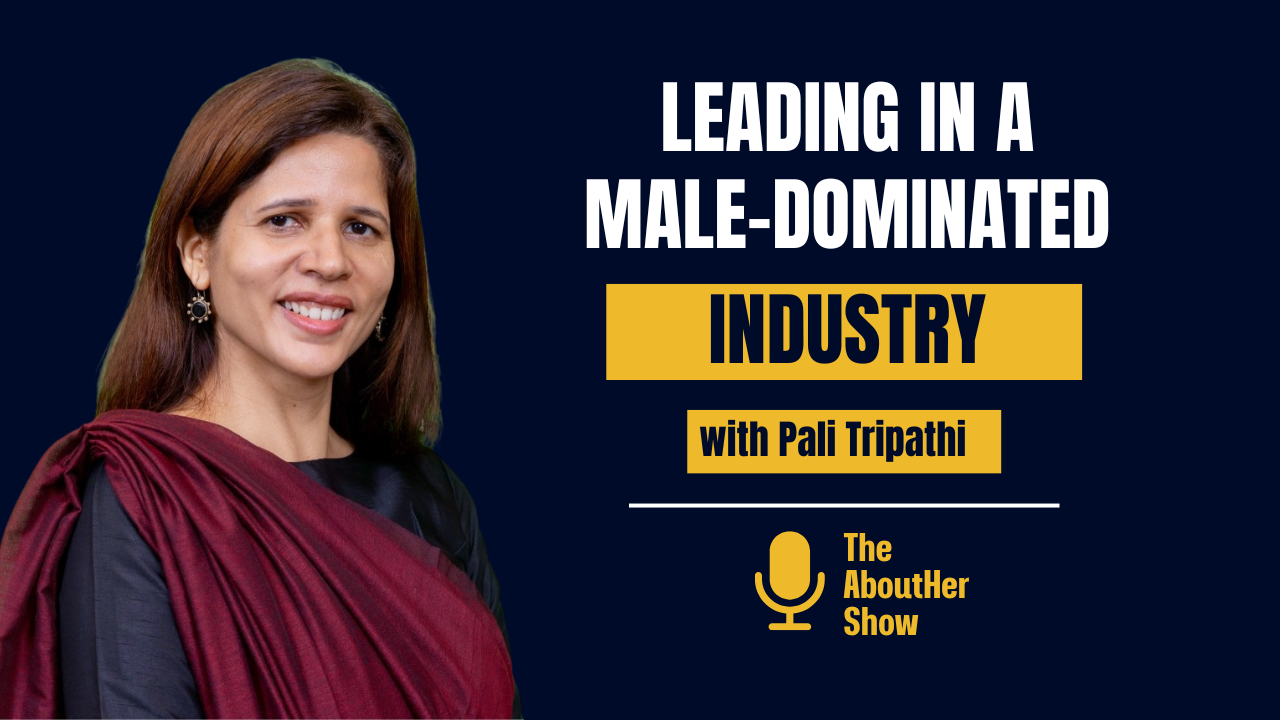
Dr. Blossom Kochhar brought aromatherapy to India when the word barely existed here. On The AboutHer Show, she tells us how she won over the doubters, why she still calls it a passion project, and what she is still learning.
“Go home, crush some garlic and put it under your feet. After half an hour, you will taste it in your mouth.”
This was Dr. Kochhar’s answer to people who told her that essential oils could not possibly travel through the body. She did not argue the point. She asked them to try it, and let their own tongues settle the question.
I have used her products for years, so sitting down with her for The AboutHer Show felt like meeting a familiar name for the first time. Her company now reaches more than 100 cities and 10 countries, and her college has trained over 35,000 professionals. So I asked her the obvious question: when did this stop being a passion project and become an industry?
She did not take the bait. “For me, this is always a passion project.”
Where it all started
Aromatherapy, she is quick to point out, was never a new science. It began in the ancient civilizations of Rome, China and India, she says, and she grew up on a coffee estate where people used jasmine, lemon and other aromatic plants without a second thought. Even today, she notes, villages across India still do.
So she did not see herself introducing something foreign. She saw something familiar that needed to be done properly. “If I can go about it in a very scientific and systematic way, people are going to accept it. Maybe they’ll take a little longer, but they will definitely accept it.”
Her double doctorate was part of that. It taught her the science of Ayurveda alongside aromatherapy, and the lesson that there has to be a system. Her blends differ according to a person’s constitution, whether vata or kapha, and she says that structure is what takes you forward. Hands-on practice matters, she told me, but with the science behind it you work in a better, more informed way.
She chose beauty as her way in, because that was her field, and found it worked on far more than skin. A cream with eucalyptus can ease a cold. One with lavender helps you relax. For her, beauty has never been only about the face. It is about the body, the mind and the emotions, and the sense of smell reaches all three. Sandalwood calms you down. Jasmine gives you confidence.
Passion first, industry second
The industry, in her telling, simply followed. What keeps her going is that she learns something new about aromatherapy every day, and that she loves watching people’s faces change when it works on them. “Behind everything anyone does, the passion has to stay alive,” I told her, and she agreed. We both felt that passion can never die. The early years were not easy. “A lot of doors were shut on me,” she says. The drug authorities had never heard of aromatherapy and were not ready to grant licences. Her answer, every time, was education. She met them, let them touch it and experience it. “Once you experience something, they’re going to believe it.” At home, she says, her family believed in her too, though she still had to bring her husband, in-laws and children fully along.
That is where the garlic comes in. She would explain that the oils have very fine molecules, that they travel into the body, help to balance it, and then leave again. Then she would hand people the test.
I asked whether being a woman made any of this harder. Her answer surprised me. “As a woman, in fact, I felt good and empowered.” Men were interested in listening, she said. She credits part of that to how she approached people. She went to them with something to find out together, never with a claim that hers was the best.
Things have shifted since. After Covid, she says, more people began using oils in diffusers instead of chemical room sprays. Education, she says, is still most of the work.
Also Read- She Lives Inside You: What a Plump Goddess Taught a Generation of Children
Skills, not handouts
When I asked what made her turn success into giving back, she started with a belief. “If you give a person money, it will only work for a little time. But if you teach them something, they can make a career out of it.”
That belief runs through the Kochhar Foundation and her college. Students learn beauty, hair and cosmetics, and some go on to work in factories. For women in villages who cannot easily leave to find jobs, the team taught them to run their own salons. When they began teaching widows who could not step out of their homes, they set up a single room in the house itself, with a mirror and a chair, for a cost she remembers as about 5,000.
The foundation also trains acid attack survivors and cancer survivors, and teaches makeup for weddings, which she calls another big area. “This is something we have to give back. It is so important to me.” India, she says, has so much more to do. People need a direction, and they need education.
Never too old to learn
Decades into building an empire, Dr. Kochhar went back to the classroom. She studied at Cambridge, and after Covid she took up machine learning in Singapore. The world had changed, she says, and she had to learn how to change with it. “Anyone in any business, you are never too old to learn.” In an industry where something shifts every little while, she says, the alternative is being left behind.
Since 2018 she has coached Femina Miss India contestants, and today she is their happiness and mindfulness coach. What she tells them has little to do with looks. Every stage has beautiful women on it. What stands out, she says, is “that air of beauty” the confidence of believing you are a winner. She gives them practical tools, from how to breathe to how to smile to how to let go of the worry that shows on the face, because talking alone does not work. She hopes the contest makes them better people, whatever they do after the crown.
Breathe in for four
A few daily practices hold her days together. Kathak gives her balance and coordination, and a reason to put on music and move. Yoga, which she has practised her whole life, supports her meditation and her breathing.
Before meeting a client, especially after a stressful appointment, she does square breathing: in for four, hold for four, out for four, hold for four, three to five times. “I can’t bring that stress into the other person’s appointment.” Golf teaches her something similar. If you are stressed, you cannot hit the ball.
Reiki and crystal therapy sit alongside all of this, not against it. Beauty, she says, should be a healing process, for the client and for her too. In her view, “beauty is body, mind, soul and spirit”, and these practices feed the spirit part.
A book from her mother’s kitchen
Her latest book, The Glow Getter’s Guide to Everyday Skincare, draws on kitchen cosmetics she learned from her mother. During Covid, when shops were shut and cosmetics were hard to find, she began sharing these recipes on YouTube. I asked what she could say in a book that she could not say in a boardroom. Her answer was practical. She cannot tell a boardroom to put yogurt and papaya on their face. Her rule is simple: what you put on your face, you should be able to eat. A Hindi edition is next, because she finds Hindi has a bigger audience.
The hardest moment, and what is unfinished
When I asked about the failure nobody asks her about, she told me about losing her husband. She was shaken completely and thought she would never get through it. Her daughter, her family, her grandson and her friends helped her believe in herself again, and her work, she says, helped too. She also named a smaller failure from the lab. Her oils need vegetable oils, waxes and emulsifiers, so a single mistake means the whole batch has to go.
What still feels unfinished? “Everything.” She never feels it is finished, she says. She keeps wanting to improve things, and that is what keeps her studying. When I said that finished would mean the end, she was quick to answer. “I haven’t stopped living. There’s miles to go, tons to do, and I want to do it.”
We closed with The Reveal, our quick-fire round. Her rule for life, followed since she was very young, is “Do unto others as you would have them do unto you.” The compliment she does not believe is being called humble. The gut decision that turned out right was aromatherapy. And the skill she wishes she had learned earlier is acting. She has now started play readings.
KEY TAKEAWAYS
1. Do the science first.
Dr. Kochhar grounded aromatherapy in Ayurveda and a systematic method, and trusted that people would accept it, even if it took longer.
2. Let people experience it.
She won over doubters and drug authorities by letting them touch, try and feel it for themselves.
3. Keep passion ahead of the industry.
After all these years, she still calls it a passion project, and the business followed.
4. Teach a skill, not a handout.
Money lasts a little while. A skill can become a career.
5. Keep learning, at any age.
Cambridge and machine learning came decades into her career, because industries keep changing.
6. Confidence outlasts appearance.
Her advice to Femina Miss India contestants is to build an air of beauty, the confidence of a winner.
7. Reset between meetings.
A few rounds of square breathing keep one appointment’s stress out of the next.
8. Nothing is ever finished.
Her answer to what feels unfinished is everything, and that is what keeps her going.
Key quotes
“If I can go about it in a very scientific and systematic way, people are going to accept it. Maybe they’ll take a little longer, but they will definitely accept it.”
“Once you experience something, they’re going to believe it.”
“For me, this is always a passion project.”
“If you give a person money, it will only work for a little time. But if you teach them something, they can make a career out of it.”
“Anyone in any business, you are never too old to learn.”
“I can’t bring that stress into the other person’s appointment.”
“I haven’t stopped living. There’s miles to go, tons to do, and I want to do it.”
Listen to the full conversation with Dr. Blossom Kochhar on The AboutHer Show, on YouTube and Spotify.
Not just about her. It takes all of us.
Share This On Social
About the Author: Sangeeta Relan

Related Posts








I’m Sangeeta Relan—an educator, writer, podcaster, researcher, and the founder of AboutHer. With over 30 years of experience teaching at the university level, I’ve also journeyed through life as a corporate wife, a mother, and now, a storyteller.