
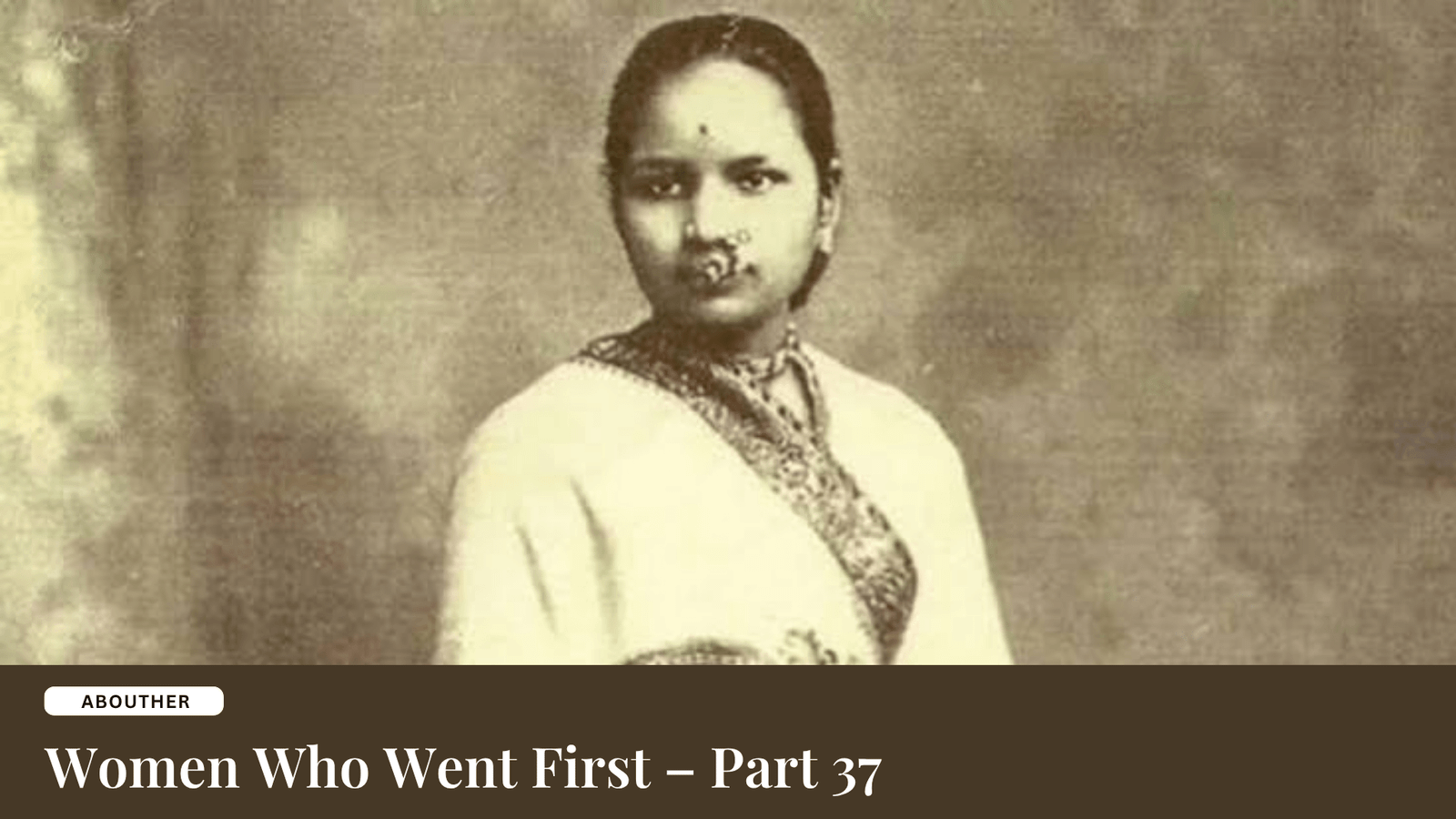
The Women Who Went First – Part 37
ISSUE 37 | THE WOMEN WHO WENT FIRST
PAST PORTRAIT
Rukmabai
1864 – 1955 • BOMBAY
The court told her to go to her husband or go to jail. She chose jail. Then she went to England and became a doctor. She was twenty-two years old.
IIn 1884, a young woman in Bombay began writing anonymous letters to the Times of India. She signed them “A Hindu Lady.” In them she described the reality of child marriage from the inside: the powerlessness of girls given in marriage before they were old enough to consent, the legal frameworks that treated women as property, the impossibility of dissent. The letters caused a sensation. Nobody knew who had written them. When the identity of the author became known, it caused a bigger sensation still.
Her name was Rukmabai Raut. She was twenty years old. She was already, technically, a married woman, though she had never lived with her husband. And she was in the middle of a legal battle that would consume the attention of colonial India, involve the British Parliament, and change the law.
The Marriage
Rukmabai was born in 1864 in Bombay. Her father died when she was two years old. Her mother, Jayantibai, remarried a man named Sakharam Arjun, a doctor and a reformer who believed in education for women. Under his influence, Rukmabai received an education unusual for a girl of her time and community.
When she was eleven years old, her mother arranged her marriage to Dadaji Bhikaji, a young man of nineteen from the same community. This was legal. It was also common. After the wedding, as was customary, she remained in her mother’s household while Dadaji continued in his own. The marriage was, in every practical sense, deferred.
Years passed. Rukmabai grew up. Dadaji did not go on to acquire an education or a profession. When she was in her early twenties, he went to court demanding she come live with him as his wife. She refused.
TIMES OF INDIA, 1884: “A HINDU LADY” WRITES
“I am one of those unfortunate Hindu women whose hard lot it is to suffer the unmentionable miseries entailed by the custom of early marriage. This wicked practice… destroys the happiness of many young women.” These words, published anonymously, were written by Rukmabai Raut. She was writing about her own life. She was twenty years old. She had been married for nine years.
The Case
Dadaji filed a suit for restitution of conjugal rights, a colonial-era legal mechanism that allowed a husband to compel his wife to return to the marital home. In 1885, the Bombay High Court ruled in his favour. Justice Pinhey’s judgment was controversial even at the time: he noted his personal discomfort but said the law gave him no choice.
Also Read: The Women Who Went First – Part 36
Rukmabai refused to comply. She said publicly that she would go to jail rather than go to Dadaji’s house. This was not a figure of speech. She meant it.
- 1875 Married at age 11 to Dadaji Bhikaji; remains in mother’s household as customary
- 1884 Begins writing anonymous letters to Times of India as “A Hindu Lady”
- 1885 Dadaji files suit; Bombay High Court rules she must return to him or face imprisonment
- 1885 She publicly states she will go to jail rather than comply
- 1886 Case becomes international; debated in British Parliament
- 1887 Dadaji accepts financial settlement; marriage dissolved
- 1889 Rukmabai departs for England to study medicine
- 1894 Qualifies as a doctor from the London School of Medicine for Women
- 1894 Returns to India; appointed Chief Medical Officer, Surat
- 1955 Dies in Bombay, age 91
The case became an international incident. Queen Victoria’s government in London was monitoring it. Social reformers including Behramji Malabari took up her cause. The debate in Britain contributed to the passage of the Age of Consent Act in 1891, which raised the age of consent for girls in India from ten to twelve years old. It was a small change. It was the first change.
The court told her the law was clear. She told the court the law was wrong. Then she waited to see which one would move first.
ON RUKMABAI’S CASE, 1885
What She Did Next
When the case was resolved, Dadaji having accepted a financial settlement, Rukmabai was free. She was twenty-three years old. She had spent the better part of a decade at the centre of a legal battle she had not chosen but had refused to lose. Most people, at that point, would have found somewhere quiet to rest.
She went to England and became a doctor.
She trained at the London School of Medicine for Women, one of the few institutions in the world that would accept women as medical students at the time. She qualified in 1894. She returned to India and was appointed Chief Medical Officer in Surat, one of the first women in India to hold such a position. She practiced medicine for decades, largely among women in purdah who had no access to male doctors and therefore, without women like her, no access to medical care at all.
THE WOMEN SHE TREATED
In colonial India, many women in conservative households could not be examined by a male doctor under any circumstances. This meant that for large portions of the female population, illness went untreated and childbirth went unattended by medical expertise simply because no woman doctor existed to provide it. Rukmabai understood this with the precision of someone who had lived inside those restrictions. She became a doctor not only because she wanted to practice medicine but because she understood, concretely, who needed her to exist. She spent thirty years in Surat providing care that her patients could not have received any other way.
The Forgetting
Rukmabai died in 1955, at 91. She had outlived the colonial government whose courts had tried to compel her back to a marriage she had not chosen. She had outlived the independence movement. She had outlived the framing of her own story as a scandal.
She is almost entirely unknown today. The Age of Consent Act, to which her case contributed, is a footnote in most histories of colonial India. Her name does not appear in standard curricula. The letters she wrote to the Times of India as “A Hindu Lady” are not widely read.
This is the particular irony of women who go first in legal and institutional terms: the progress they force becomes the baseline, and the baseline looks as if it was always there. Nobody remembers who built the floor they are standing on.
CROSS-SERIES CONNECTION
In Issue 29 of this series, we profiled Pandita Ramabai, who in the same era was fighting for widows’ rights and women’s education, and who also drew the fury of an establishment that found educated, opinionated women inconvenient. Both women operated in 1880s India, both used writing and public argument as weapons, and both built something institutional afterward: Ramabai the Mukti Mission, Rukmabai a medical career in Surat. They never met, as far as the record shows. They were doing the same work in different rooms of the same building.
Why She Belongs in This Series
The Women Who Went First is about women who entered rooms that were not designed for them. Rukmabai entered a courtroom as a defendant and turned it into a platform. She wrote to a newspaper anonymously because no woman in 1884 could write under her own name about her own marriage without destroying herself, and she wrote anyway. When the court ruled against her, she chose the consequence over the compliance. When it was over, she built a life from the wreckage with such purposeful efficiency that the wreckage barely shows.
She is here because child marriage is still practiced in India today, and the first woman to say publicly, in print, in a court of law, that it was wrong to do this to a girl deserves to be known by name. She is here because she chose jail over submission at twenty-two years old and then went to London and came back a doctor. And she is here because the floor we are standing on was built by someone, and her name was Rukmabai.
ISSUE 37 • PAST PORTRAIT • ABOUTHER MAGAZINE
THE WOMEN WHO WENT FIRST
Share This On Social
About the Author: Sangeeta Relan

Related Posts


I’m Sangeeta Relan—an educator, writer, podcaster, researcher, and the founder of AboutHer. With over 30 years of experience teaching at the university level, I’ve also journeyed through life as a corporate wife, a mother, and now, a storyteller.