She Doesn’t Wait for Permission
ABOUTHER MAGAZINE • VOICES | IDEAS | LIVES
She Doesn’t Wait for Permission
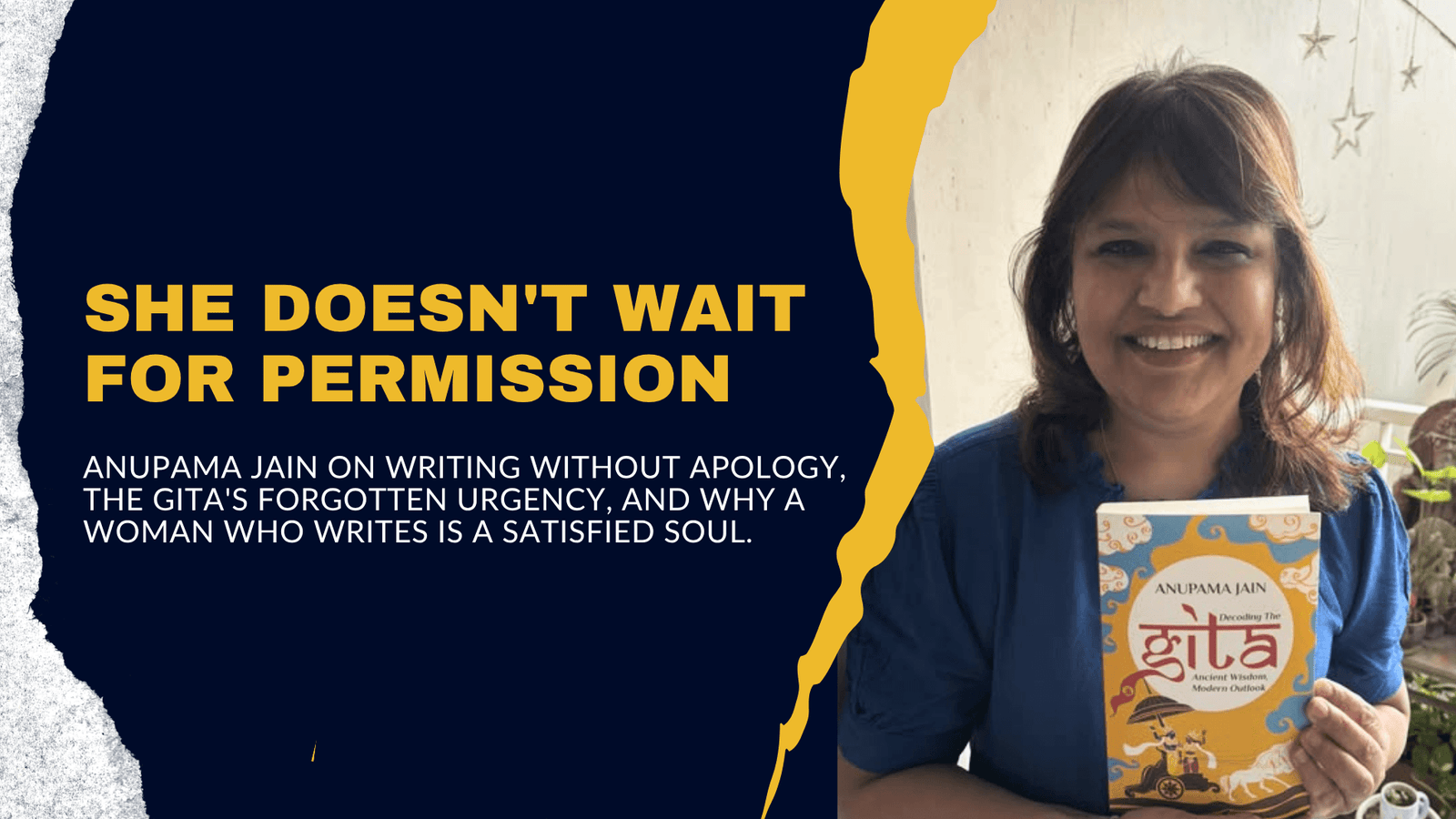
Anupama Jain on writing without apology, the Gita’s forgotten urgency, and why a woman who writes is a satisfied soul.
By Sangeeta Relan
Anupama Jain has not changed her WhatsApp status in eight years. Six words, and she has never needed another: Own it, embrace it, and run with it. Not a quote she borrowed, but a philosophy she earned the moment her first book came out and decided she was done waiting for the world to make space for her.
AJ, as she is known, is the author of six books spanning children’s fiction, adult humour, mythology retelling, and now philosophy. She runs SeniorSchoolMoms, a 10,000-strong community she built without taking a single rupee for it. She has co-founded a startup, mentored at a national level, taught creative writing in schools, won awards for her satirical column AJ Wants to Know, and recently reinterpreted the Bhagavad Gita for a generation that needs its wisdom but rarely has the patience for its volume. Her latest, Decoding The Gita: Ancient Wisdom, Modern Outlook, has been selected for the FICCI Bologna Book Plus Rights Catalogue 2026.
When she walked into our conversation, she brought all of it with her, the writer, the teacher, the community builder, and the woman who has spent a lifetime learning to take up space without guilt.
I always write for myself first. The icing on the cake is if it finds echo in other hearts.
Writing as Restlessness
Ask AJ who she writes for and she does not hesitate. She writes for herself, every single time. The reader comes second, not out of indifference but out of honesty. She describes the compulsion to write as a physical sensation, a restlessness that builds until the buzzing thoughts in her head take a concrete shape on the page. Only after she has blurted it all out does she wonder whether it will find resonance with anyone else.
It almost always does. Because, as she puts it, no man is an island. What agitates her tends to agitate the rest of us too.
This dual life between the column and the book has shaped her craft in ways she did not anticipate. The column, AJ Wants to Know, is what she calls instant noodles. Immediate traction, immediate feedback, immediate obsolescence. A book is the dal makhani that has been simmering for 24 hours, seasoned with care, every ingredient measured. Both demand skill. Both demand honesty. And doing both, she says, makes you a more complete writer.
A column gives you instant euphoria. A book builds long-term credibility. I need both.
The Gita and the Question Nobody Asks
When her publisher called one evening in February 2025 and asked, without preamble, whether she wanted to write about the Gita, AJ said yes before she understood what she was agreeing to. She put the phone down and then the enormity of it hit her. Seven hundred shlokas. Multiple interpretations. A text so sacred the Prime Minister takes his oath holding it.
Also Read: She Didn’t Start Over. She Started Deeper.
She read the Gita at least five times before writing a single word. What she noticed was that most interpretations treat it as a religious document, something you keep on your shelf and do not quite open. But the Gita is not a religious text, she argues. It is a life text. A soul sculpting manual. And its most profound philosophy unfolds not in a temple or a court, but in the middle of a battlefield, in the moment of Arjuna’s complete collapse.
That collapse was her entry point. She structured the book as a story, moving through vulnerability, confusion, the search for clarity, action, and finally surrender. It is the classic narrative arc. It is also the arc of every human crisis worth writing about.
At the end of each chapter she placed two things: a parallel from world literature, and an implementable life hack. Hamlet, she found, was the perfect first companion. Arjuna’s dilemma, to wage war against his own kin or walk away from everything, is Hamlet’s dilemma at its core. To be or not to be. She believes Arjuna got there first and Hamlet simply followed.
The Gita is not a religious book. It is a soul sculpting manual. And everyone is busy sculpting their figures.
The Cost Nobody Mentions
Co-founding a startup taught AJ something she had never seen written about honestly: that it costs you a little bit of your femininity. Not in any dramatic sense, but in the daily negotiation of being taken seriously in rooms built for men. She was often treated as the boss’s wife to be indulged, someone whose ideas would be listened to politely and then set aside once she left. She learned, slowly and through hard experience, to be assertive without losing her warmth, to insist without losing her voice.
And then came the compliment that stopped her cold. At the end of all that effort, the highest praise she could hope for was: she thinks like a man. She does not celebrate it. She names it, clearly and calmly, for what it is.
The best compliment you can hope for is: she thinks like a man. That tells you everything about how far we still have to go.
On Owning the Unconventional Life
AJ pays her bills through mentoring and creative writing consultation. Everything else, the community, the writing, the column, the speaking, she does because it feeds something the salary cannot. She is unapologetic about this arrangement, not because money does not matter but because she has worked out exactly what it is for. Money, she says with characteristic wit, might not buy you happiness, but it sure upgrades the suffering.
SeniorSchoolMoms, now 10,000 members strong, has never charged anyone a rupee. People look at her like she has lost her mind. She looks back at them and carries on. Not everything is for money. Some things are for the sleep you get at night when you know you did something that mattered.
Her Padma series began as a 300-word short story about a woman in a lift, entered into a humour competition where it won third or fourth prize. Her publisher saw it and asked her to pull a novel out of it. She had no idea who Padma was, what her backstory held, or where she was going. She pulled two rabbits out of that hat. Padma, she is clear, is far wilder than she is. But they share one thing: both are phoenixes. Both have fallen, dusted themselves off, and kept going.
Wear that damn crown already. And light up the path for the people who are waiting to follow you.
5 THINGS TO TAKE WITH YOU
01. Write for yourself first. Resonance is the reward, not the reason.
02. The Gita is not a text to keep on your shelf. It is a framework for anyone navigating crisis, confusion, and the pressure to act.
03. The female founder’s interior experience rarely gets told. The cost is real, and naming it honestly is the first act of leadership.
04. An unconventional portfolio is not a failure to commit. It is a refusal to be flattened into a single version of yourself.
05. Don’t let people’s opinions sit rent free in your head. The moment you do, you have given away the control of your mind.
Anupama Jain’s Decoding The Gita: Ancient Wisdom, Modern Outlook is available now on Spotify, Apple Podcasts, YouTube, and all major platforms.
Share This On Social
About the Author: Sangeeta Relan

Related Posts








I’m Sangeeta Relan—an educator, writer, podcaster, researcher, and the founder of AboutHer. With over 30 years of experience teaching at the university level, I’ve also journeyed through life as a corporate wife, a mother, and now, a storyteller.