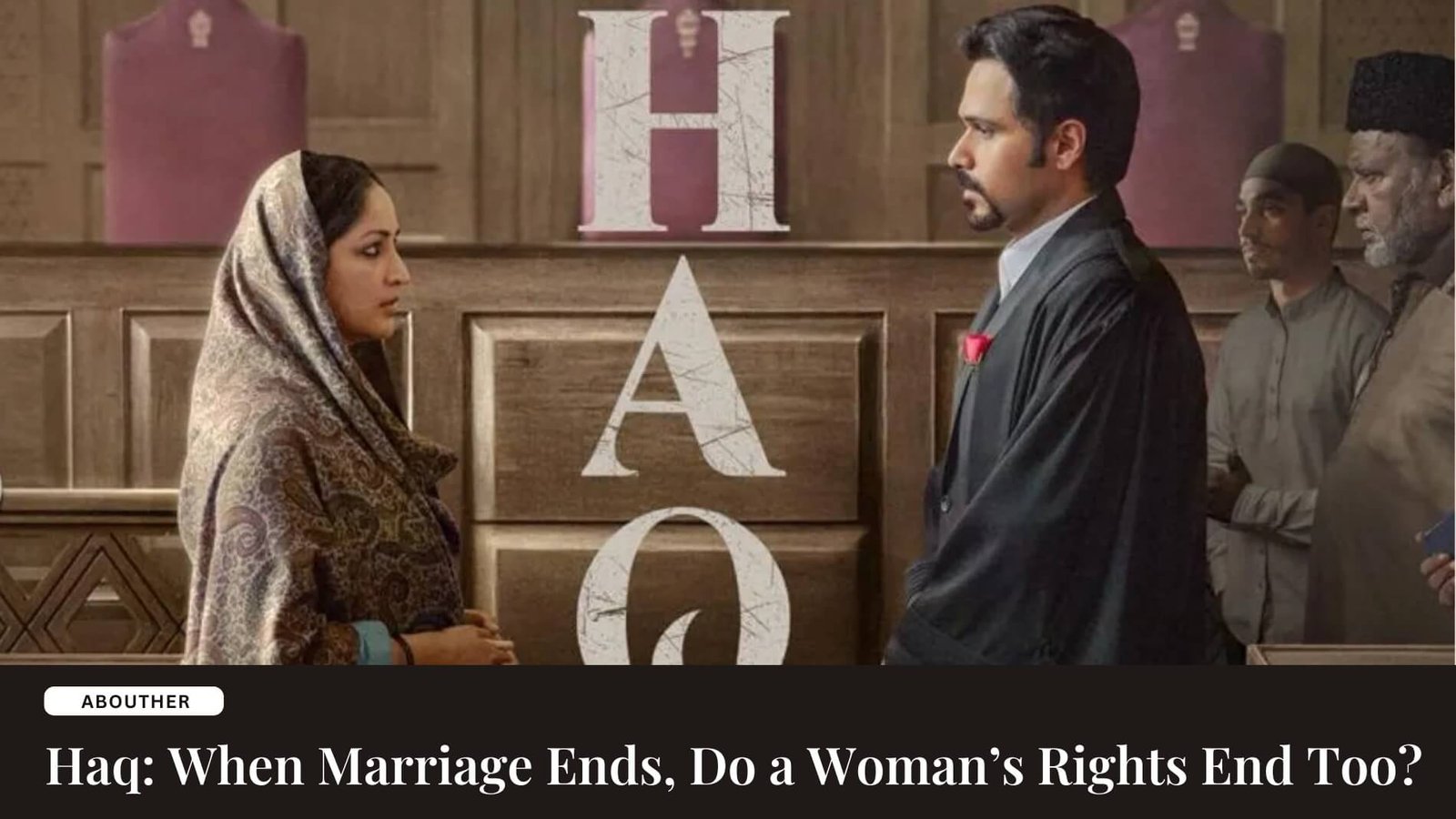
Haq: When Marriage Ends, Do a Woman’s Rights End Too?
In a society where marriage is often seen as the ultimate marker of a woman’s fulfilment, what happens when that marriage fractures? What remains of her dignity, her security, her voice, and her haq?
The Hindi film Haq, led by Yami Gautam Dhar and Emraan Hashmi, asks these uncomfortable questions with quiet force. Inspired by real legal history yet deeply emotional in its storytelling, the film goes beyond the courtroom to examine women’s rights within marriage, the fragile dynamics of relationships, and the unseen emotional cost borne by children when adult choices unravel families.
At its core, Haq is not just a legal drama. It is a social mirror.
While Haq is a fictionalised narrative, it draws inspiration from the landmark Shah Bano case of the 1980s, a moment that forced India to confront uncomfortable questions about women’s rights, personal laws, and constitutional equality. By revisiting this history through a contemporary cinematic lens, the film reminds us that the debates around a woman’s financial security, dignity, and autonomy after marriage are not relics of the past. They continue to echo in courtrooms, homes, and lived realities even today.
A Woman’s ‘Haq’ Beyond Marriage
The word haq, meaning right, is loaded with meaning. In the film, it represents more than a legal entitlement. It symbolises a woman’s right to dignity, financial security, and autonomy after years of emotional labour within a marriage.
Yami Gautam Dhar’s Shazia begins her journey as many women do, anchored in her role as a wife and mother. When her marriage breaks down, she is expected to quietly disappear into the margins of society, stripped of economic safety and social standing. What Haq powerfully exposes is how often women are asked to “adjust” once again, this time to abandonment, not only by men but women as well.
By choosing to seek legal recourse, Shazia challenges a deeply ingrained belief: that a woman’s rights end where her marriage does.
Her fight is not portrayed as defiance for its own sake, but as survival. It is about reclaiming self-worth in a system that often treats divorced or separated women as inconvenient footnotes rather than individuals deserving justice.
Marriage, Power, and Emotional Asymmetry
Haq dismantles the romanticised idea of marriage as an equal partnership. Instead, it shows how marriage can quietly become a site of power imbalance, where men’s choices are protected by social norms, while women are left to manage the fallout.
Emraan Hashmi’s portrayal of the husband adds to this tension, embodying the quiet entitlement that society often excuses. The film asks difficult questions:
- Why is male autonomy in marriage often normalised, while female assertion is labelled disruptive?
- When relationships break, who bears the emotional, financial, and social cost?
Also Read: From Silence to Selfhood- Women’s Redemption in Hindi Cinema
One partner exercises choice; the other faces consequences. This asymmetry is not unique to the film, it mirrors lived realities for countless women who find themselves navigating abandonment, remarriage, or emotional neglect without institutional support.
Children: The Silent Witnesses of Broken Marriages
One of the film’s most poignant strengths lies in how it portrays children, not as background characters, but as emotional participants.
Shazia’s children witness:
- the slow erosion of security,
- the anxiety of financial instability,
- and the emotional toll of watching their mother fight for what should have been hers by default.
Haq reminds us that marital breakdowns are not private adult failures, they reshape childhoods. Children absorb fear, confusion, and instability long before they understand legal terminology, which Shazia brings forth when she talks about how her children behave. Courtrooms, paperwork, and uncertainty become part of their growing-up years.
The film subtly yet powerfully reinforces an often-overlooked truth: when women fight for their rights, they are often fighting for their children’s futures too; futures which husbands conveniently ignore and then wonder why children don’t respect them.
Law, Society, and Gendered Justice
Set against the backdrop of a legal battle, Haq also invites reflection on how law intersects with gender, culture, and morality. It highlights how personal laws, social expectations, and institutional structures frequently fail women at moments when they are most vulnerable.
But the film is careful, it does not reduce the issue to ideology alone. Instead, it grounds its narrative in lived experience, asking viewers to consider whether justice can truly exist if it ignores emotional labour, unpaid care, and years of invisible contribution.
Finally, Haq is not just a film about a woman in court. It is about every woman who has been told to “manage,” “move on,” or “stay quiet” when her world collapses. It is about children who learn resilience too early. And it is about a society still learning to see women not as extensions of marriage, but as individuals with rights that do not expire.
Share This On Social
About the Author: Sangeeta Relan

Related Posts







I’m Sangeeta Relan—an educator, writer, podcaster, researcher, and the founder of AboutHer. With over 30 years of experience teaching at the university level, I’ve also journeyed through life as a corporate wife, a mother, and now, a storyteller.