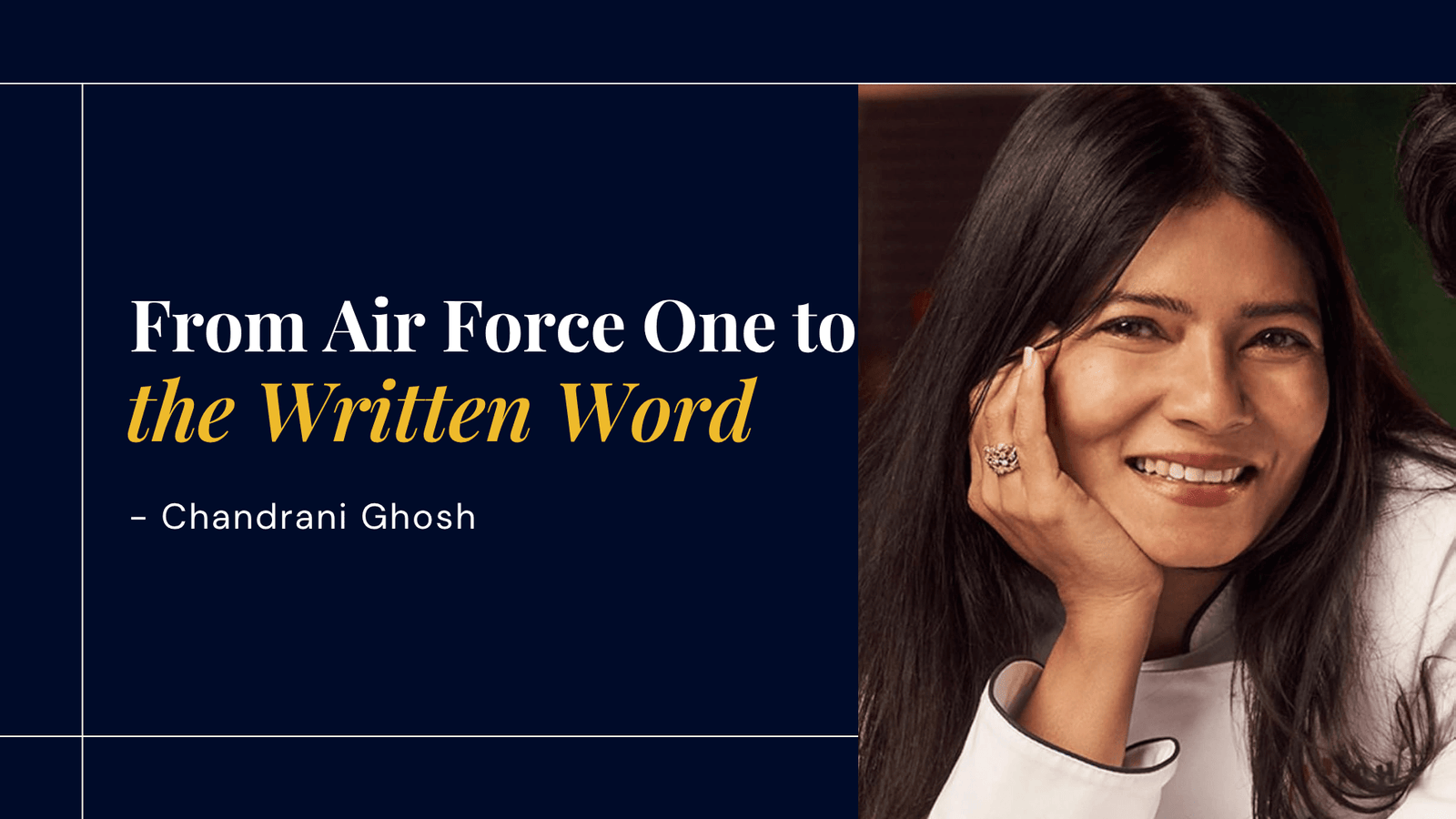
From Air Force One to the Written Word
ABOUTHER – WOMEN · STORIES · POWER
From Air Force One
to the Written Word
to the Written Word
Chandrani Ghosh spent decades inside the world’s most powerful rooms the Clinton White House, Forbes billionaire lunches, K Street lobbyist dinners. Now she has turned that ringside view into Heartlines, a debut novel that asks: what does it really cost to have everything?
Key Takeaways
01
02
03
04
There is a particular kind of knowledge that only comes from being in the room. Not reading about it, not watching it on screen but actually being there. Chandrani Ghosh has spent a lifetime accumulating that knowledge: on Air Force One with President Clinton, at lunch with Richard Branson, inside the marble corridors of Capitol Hill. And now, she has done something quietly radical she has turned it all into fiction.
Her debut novel, Heartlines, is set in the Washington DC she knows with an insider’s intimacy: the wine at White House state dinners versus K Street lobbyist parties (she knows which is more expensive), the secret hideaways senators keep tucked away from public view, the specific electricity that fills a room when real power walks in. But this is not a memoir dressed up as a novel. Chandrani’s most daring move is asking a question that no press credential ever prepares you to answer: what happens to a woman who has everything and still feels incomplete?
“When I talk about the wine being served at a lobbyist party on K Street versus the wine at a White House state dinner I know what I’m talking about. I’m not just throwing it out there. I can tell you where more money is being spent.”
— Chandrani Ghosh
A Life Shaped by Many Worlds
Chandrani’s biography reads like the itinerary of someone constitutionally incapable of staying still: Kolkata, Delhi, London, Geneva, Kathmandu, and finally Washington DC. Far from unsettling her, this peripatetic life gave her something increasingly rare in a polarised world the ability to see across difference.
“Living in so many places makes me less polarised in my view,” she says. “In Geneva, the Swiss show up exactly at seven if you invite them at seven. And then there are the Indians and yet at some level you also realise we’re all human. The same things bother all of us: the jealousies, the heartaches.” She pauses, then adds with characteristic directness: “We are so different, and yet at some level we’re all human. I wish in this very polarised world we could see that.”
This deeply humanist worldview is not a philosophical position so much as a lived one. And it saturates Heartlines a novel whose characters span first-generation immigrants, American-born children of the diaspora, and the particular nowhere-land that belongs to those caught between both.
“It’s really strange to my children when they say ‘where are you from’ and they say Washington DC, someone will say, ‘No, no, where are you really from?’ And you know, they look at them that’s a really strange question.”
— Chandrani Ghosh, on belonging
From the Newsroom to the Novel
Before Chandrani became a novelist, she was the journalist in the room. As South Asia bureau chief and White House correspondent for Time, she flew on Marine One and travelled with the presidential motorcade through a cleared Manhattan an experience she describes as “heady.” At Forbes, she worked on the legendary Rich List, lunching with Richard Branson and fielding calls from Donald Trump’s office.
But what she took away from those encounters was not glamour it was insight. “I came to understand what it is about power that is so attractive,” she reflects. “Think of it: you fly into New York on Air Force One, you land, the streets of Manhattan are shut for you. You whiz down to Radio City Hall. You could see why someone in that position would do anything to keep it the power of that power to attract is enormous.” That understanding of power’s seductive force lives in the bones of her fictional senator Lionel, who “gets” power in a way that her tech-world character simply does not.
Her move from journalism to fiction, she insists, was not a rejection of one calling for another. It was a deepening. “In journalism, I’d meet someone with a fascinating story and I could only give it one mention,” she says. “I loved the people part getting to know them. And writing a people-centric story was not that much of a leap.” Her family background helped: two well-known writer cousins and an uncle with several published books meant that the world of literary creation was never alien to her.
The Love Triangle as Life’s Crossroads
Heartlines centres on Sharmila Basu, a Washington-based journalist caught between two men and, more profoundly, two versions of the life she might lead. But Chandrani resists reducing her novel to a simple romantic drama.
“I think of a love triangle as really not just about the men or the women,” she explains, “but about lives that we could have had or not had. When you choose, you say no to something. You turn down a path. And we don’t know where that path would have led.” The love triangle, in her framing, becomes a universal metaphor the inflection points at which most of us stand, usually without recognising them as such, before one choice closes a thousand doors and opens another life entirely.
“Many people have made these choices they just never thought about it. They were at points of inflection. They could have gone this way or that way. Which one they picked is what they’ve ended up with.”
— Chandrani Ghosh
Her protagonist Sharmila is drawn, she acknowledges, from her own experience the young woman who starts fresh in a new country, who works her way up from intern to byline, who navigates a newsroom environment that is supportive and paternalistic in equal measure. “Even in the best of situations, sometimes the patriarchy is so strong,” she says. “Even when you’re doing well, it’s a little ‘wow, you’re doing well’ not the same energy as when a man does well.”
The Illusion of Having It All
Perhaps the novel’s most resonant thread and the one closest to what Chandrani has witnessed in life is its examination of visible success and invisible unhappiness. Sharmila lives in Georgetown, dates an American heartthrob, commands the newsroom’s best assignments. And yet something is missing.
“I’ve seen very very successful people very close up the billionaires from Forbes, but also the high-achieving Indian-Americans in DC politics and media,” she says. “When you’re young and on the outside, you look at them and think: if I could only be there, what a perfect world it would be. And then you get to know them personally and some of them, oh my God, they’re really struggling. They’re unhappy. There is so much.” She allows a beat of silence. “I wanted to explore that: this picture-perfect world that is not perfect.”
Also Read: From Mother to Movement
It is a theme that lands differently depending on where you sit in life and Chandrani knows it. For younger readers, Sharmila’s restlessness may feel like betrayal. For those who have been there, it will feel like recognition.
“None of my characters are perfect. They’re all flawed and you can still fall in love with them. Their flaws make them human. All of them are likable even when they’re doing the wrong things.”
— Chandrani Ghosh
The Journalist’s Gift to Fiction
Readers of Heartlines have noted something immediately: the book moves. It doesn’t sag. It doesn’t overstay its welcome in any scene. Chandrani credits years of American-style journalism training precision, economy, no wasted words for that quality. “I was really taught to be precise,” she says. “Not to pad too heavily, not to have lots of superfluous words. Be direct, be to the point.” That discipline, she believes, gives the novel its clean, effortless pace.
But journalism gave her more than style. It gave her the instinct to look at the person behind the story always. The habit of asking not just what happened, but why this person, with this history, made this choice in this moment. That instinct, applied to fictional characters, produces the kind of moral complexity that keeps readers turning pages even when no one is behaving well.
The Freedom of Imagination
After more than a decade of telling other people’s stories, Chandrani describes writing fiction as something close to reclaiming a part of herself she had forgotten. “As children, we’re allowed to have deep imaginary worlds,” she says. “We play house, we play teacher, we play doctor. And then as adults, we stop. But being a writer gives you back that licence your imagination gets to run free. And that is deeply, deeply fulfilling.”
She is already looking forward. Heartlines is a beginning, not an arrival. And for a woman who has ridden in Marine One, interviewed the world’s richest people, and raised a family between cultures that enthusiasm for what comes next feels entirely, characteristically, her own.
“I had not realised how fulfilling it is to let that creative side explore. As adults, we don’t get that chance. But being a writer allows you to do that and that is your job. You are allowed to be.”
— Chandrani Ghosh
Heartlines by Chandrani Ghosh is available now. This interview was conducted by Sangeeta Relan for the AboutHer podcast.
Share This On Social
About the Author: Sangeeta Relan

Related Posts






I’m Sangeeta Relan—an educator, writer, podcaster, researcher, and the founder of AboutHer. With over 30 years of experience teaching at the university level, I’ve also journeyed through life as a corporate wife, a mother, and now, a storyteller.